Saturday, 20 September 2014

CAPE 1 - Water: Introduction

WATER

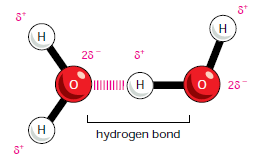
A water molecule consists of one oxygen atom covalently bonded to two hydrogen atoms. 

  • the electrons are not shared perfectly evenly: the oxygen atom is capable of pulling them towards itself and further away from the hydrogen atoms. 
  • The result is that the oxygen part of the molecule becomes slightly negatively charged, and the hydrogen atoms slightly positively charged. 

Water is therefore described as a polar molecule (polar means charged internally).


Two atoms, connected by a covalent bond, may exert different attractions for the electrons of the bond. In such cases the bond is polar, with one end slightly negatively charged and the other slightly positively charged.


HYDROGEN BONDS

  • Because they are polarized, two adjacent H2O molecules can form a linkage known as a hydrogen bond. 
  • Hydrogen bonds have only about 1/20 the strength of a covalent bond.
  • Hydrogen bonds are strongest when the three atoms lie in a straight line.


WATER STRUCTURE

  • Molecules of water join together transiently in a hydrogen-bonded lattice. 
  • Even at 37oC, 15% of the water molecules are joined to four others in a short-lived assembly known as a “flickering cluster.”
  • The cohesive nature of water is responsible for many of its unusual properties, such as high surface tension, specific heat, and heat of vaporization.


HYDROPHILIC MOLECULES

Substances that dissolve readily in water are termed hydrophilic. 

  • They are composed of ions or polar molecules that attract water molecules through electrical charge effects. 


  • Water molecules surround each ion or polar molecule on the surface of a solid substance and carry it into solution.


HYDROPHOBIC MOLECULES

Molecules that contain a preponderance of non-polar bonds are usually insoluble in water and are
termed hydrophobic. 
This is true, especially, of hydrocarbons, which contain many C–H bonds.

  • Water molecules are not attracted to such molecules and so have little tendency to surround them and carry them into solution. 

  • This is known as formation of micelles. One very good example is shown below.


Saturday, 13 September 2014

Feeding Relationships - pyramids

Now you have started thinking about the numbers of animals, the population sizes.
A population is a group of animals of the same species living in an area.
These are never exactly the same but over time they fluctuate about a constant level. There are six factors that can affect the population size, these are shown in the following diagram:


If the birth rate increases the population size will increase.
If the death rate increases due to an increase in predators the population size will decrease.
If competition increases the population will decrease.
Competition occurs when another species that eats the same food (or occupies the same space) comes into an area.
The other two factors are less common. They arise if animals move from one area to another, usually in migration.
You need to be able to answer questions that suggest a factor and ask what effect it would have on population size. Other factors might be the effects of a disease, or of changes in available light, or space, among other factors.
Now lets look at how two populations interact.
How do the numbers of a predator effect the numbers of its prey?

You can see that as the number of herbivores increases it is followed slightly later by a rise in the population size of the carnivores. There is a time lag between the two. This is due to the time it takes for carnivores to adjust to the presence of more food i.e. to produce baby carnivores.
If too many herbivores are eaten and their numbers drop, what happens?
There is a time lag and then the numbers of carnivores also falls. This is because there are too few herbivores for all the carnivores to eat and so some starve.
It's a hard life!
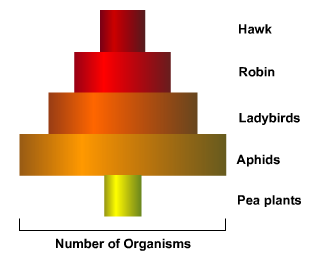
A nice way to show the size of different populations of organisms is by building a pyramid.
If you count up how many of each type of organism you have you can set up a pyramid of numbers like this:

The width of each trophic level tells you how many there are of each type. As you go up the pyramid there are fewer individuals on each trophic level.
It can be done for an individual food chain such as the one we had originally. Although it looks a little odd since there are only a few pea plants.

This is because when food chains or webs include plants such as trees there are only a few but they are very large.
A different way to show these food webs is to do a pyramid of biomass.
To do this you take the total masses of the individuals at each trophic level. So you need to go round and weigh each plant or animal.
Have you tried to weigh a tiger?
The final pyramid of biomass looks similar to the pyramid of numbers.
Tricky!

The main difference between them is that pyramids of numbers can look 'wrong' as there might only be one tree on the bottom trophic level. Pyramids of biomass always look right, since a tree will weigh much more than anything else.
So in an exam always be careful that you know which pyramid is which!
All this talk of food!
But why do we need food?
We only eat because we need fuel for respiration.
Respiration gives us energy which we use for growth, activity and so on.
The Sun is the ultimate source of all the energy in the environment. However the producers can only capture a small fraction of it using photosynthesis.
When plants get eaten by an animal what happens to any of that energy stored in them?
It is passed on to the animal - the consumer. The same happens if that animal is then eaten by another.
However not all the energy is available, some is lost at each stage.
The reasons for this include the energy for staying alive and growing. Any extra energy is stored, usually in the form of fat.

The amount of energy and biomass lost at each stage is about 90%.
In a fully grown animal 90% of the biomass it eats is lost in the faeces - that's why you can burn them for fuel. Try it sometime!

So the amount of energy that gets to the top carnivore is a fraction of that given out initially by the sun. By the time the hawk gets its energy there is only about 0.01% of the energy present in the pea plants. Not much!
This explains why pyramids of biomass have the expected shape. The amount of biomass (or energy) gets less each time you move up to the next trophic level.
So little energy is left by the end of a food chain that they cannot get too long. In fact the shorter they are the better. That's why on those survival programmes they spend so much time eating worms!
A better idea is to eat plants yourself, like vegetables, fruit and grains. They will provide you with more energy than you would get from raising a herd of cows on the same piece of land.
Losing one trophic level means that you get more energy at the end. It is more efficient.
Before you become a total vegetarian you do need to remember about vitamins and minerals. Deciding on such a diet needs careful thought to avoid malnutrition.
Intensively reared livestock are kept in restricted conditions so that they do not 'waste' energy moving around. However, apart from the ethical questions, they still end up wasting energy from their food.
Land can feed more people if used for crops. However some land such as hillsides and marshy areas are not suitable for crops and so rearing animals on it is the most efficient use.

Any organism has to keep up with any changes in their environment. They have to adapt in order to survive.
Adaptation means making changes in what you do or how you do it. Without the necessary changes you will fail to compete and die.
A favourite exam question is to ask you to think why a particular characteristic helps an animal or plant survive. Each has to adapt to its own niche - the place where it lives and fits into the local environment.
For example: a rabbit has the following adaptations to its life as a prey animal:
AdaptationSurvival advantage
Large earsTo hear predators
Thick brown furGood camouflage and for warmth
White tailTo act as a warning flag to other rabbits when its running away!
Fast and agile runningTo avoid predators
Eyes on side of headAllows all-round vision to watch for predators
Food webs and the size of populations has probably made you realise how interconnected things are in the environment.
This is not just true about the plants and animals but it is also the case for all the chemical molecules present on the Earth. The atoms that make them up cannot be destroyed, they just get moved around and around.
So if you look at a particular type of chemical you can follow it as it goes through a cycle in the environment. The best known are the carbon and nitrogen cycles.
First of all the chemicals need to get out of the animals or plants that they are in, this occurs through the process of decomposition.
All things die, sadly. But their molecules go marching on!
The cells and bodies of plants and animals decay by the action of soil bacteria and fungi. They are often called the decomposers. (There's a joke about Beethoven there somewhere).
The molecules released during decay are absorbed by the bacteria, fungi and also back into the soil from where plants can draw them up through their roots.
The decomposers work best at their optimum conditions since they use enzymes. The kind of conditions needed are shown nicely by the humble compost heap.

There are five necessary conditions or factors for good decomposition:
  1. Organic material: plant or animal material to decay
  2. Water: the right amount of moisture
  3. Oxygen: air must be able to get to the material
  4. Warmth: the temperature cannot be too hot or too cold
  5. Decomposers: bacteria or fungi are needed to do the job
You would not get decomposition if one of these was missing.
The molecules released by this decay process include the most important elements carbon and nitrogen which have their own environmental cycles.

thanks to www.s-cool.co.uk

Feeding Relationships - chains and webs

Living in the wild is pretty dangerous!
You spend all the time trying to find your dinner and avoid ending up as someone else's.
We can look at who eats whom in the environment by setting up food chains and food webs. They help us by breaking up the environment into understandable bits.
With a food chain you always start off with a plant as they produce all the energy in the environment from photosynthesis. A plant is therefore called a producer.
Herbivores are animals that eat plants and they are placed next in the food chain. They consume the plants and so are also the primary consumers.
To show that the herbivore eats the plant in our chain we use an arrow.
The example food chain below shows this:


The direction of the arrow is very important. It shows who is eaten by who.
So in our example the maize is eaten by the locust, which are in turn eaten by the lizard, and so on.
If the locust are the primary consumers here, or the herbivores, the lizard is the secondary consumer. Then the snake is the next (tertiary) consumer, and so on.
The snake does not just eat other animals but will sometimes also eat fruit and nuts. Therefore you could actually call it an omnivore.
The animal that occupies the other trophic level is the top carnivore as nothing else will eat it.
Our example was very simple. Usually in natural ecosystems they are more complex, this is because one predatory species will usually eat more than one prey species.
What would happen if you were an animal that only ate one animal or plant?
If that food source ran out, you would starve to death. Not a good idea.
Another good idea for eating up your greens!
Animals tend to eat food from a variety of sources, different plants and animals.
Therefore our food chain is not very accurate, it does not cover all the connections.
In order to obtain a more accurate idea of what is going on we need to construct a food "web":

The food web attempts to show which organisms eat any other animal. They can get pretty complicated but are still as easy to read as a food chain. Just remember the arrows.
Now think about what happens if one animal species gets wiped out.
What do the snakes and the kingfishers do if all the frogs disappear?
The snakes will die out but the kingfishers will just start eating more trough and carp

Sunday, 2 February 2014

Variety within a species

Natural selection

Within a population of animals, plants or any living organisms, there will be inherited variations. Within each species the individuals with the variations best suited to the environment will survive better than the others. More of them will survive to reproduce than the others. When they do, they pass on the genetic information for these variations to their offspring.
Species gradually evolve in this way. This process is called natural selection.
Over time a population can change so much it may even become a new species, unable to reproduce successfully with individuals of the original species.

One good example is the peppered moth:
When newly industrialised parts of Britain became polluted in the nineteenth century, smoke killed lichens growing on trees and blackened their bark. 
  • Pale coloured moths which had been well camouflaged before when they rested on tree trunks became very conspicuous and were eaten by birds. 
  • Rare dark moths, which had been conspicuous before, were now well camouflaged in the black background. 
  • As birds switched from eating mainly dark moths to mainly pale moths, the most common moth colour changed from pale to dark. 
  • Natural selection had caused a change in the British moth population. The moths had evolved.

Another example is Natural Selection in Darwin's Finches:
  • These birds, although nearly identical in all other ways to mainland finches, had different beaks. 
  • Their beaks had adapted to the type of food they ate in order to fill different niches on the Galapagos Islands. 
  • Their isolation on the islands over long periods of time made them undergo a genetic change as well as the physical change.

Artificial selection

Artificial selection is when people use selective breeding to produce new varieties of a species. A variety is a type of a particular species that is different in some clear way from other varieties of that species.
For example, pedigree dogs come in lots of different varieties, called breeds of dog. They may be different colours and sizes, but they are all still dogs. They are all still the same species. Different varieties of dog have been produced by selective breeding.

Selective breeding of cows

Suppose you wanted a variety of cow that produced a lot of milk. This is what you could do:
  • choose or select the cows in your herd that produce the most milk
  • let only these cows reproduce
  • select the offspring that produce the most milk
  • let only these offspring reproduce
  • keep repeating the process of selection and breeding until you achieve your goal.
Our own Jamaican Scientists Dr. T.P. Lecky carried out such and experiment to create tow new breeds or variety of Jamaican cows. The Jamaica Hope bread as milk producers for our tropical climate  and the Jamaica red which is our major beef producers.

Other examples of selective breeding

The key here is to identify the feature you want, and only breed from the individuals that have that feature. Here are some examples of what selective breeding can produce:
  • hens that lay big eggs of a particular colour
  • cattle that produce lots of meat
  • tomato plants that produce lots of tomatoes
  • crops that are resistant to certain plant diseases.

Genetic Variation - continuous & discontinuous

Continuous & discontinuous

Some of the features of the different organisms in a species show continuous variation, and some features show discontinuous variation.

Continuous variation

Human height is an example of continuous variation. Height ranges from that of the shortest person in the world to that of the tallest person. Any height is possible between these values. So it is continuous variation.
For any species a characteristic that changes gradually over a range of values shows continuous variation. Individuals cannot be grouped into distinct & discrete phenotypes. Character is easily influenced by environment and can be measured or graded. 
Examples of such characteristics are:
  • height
  • weight
  • foot length.
If you record the heights of a group of people and draw a graph of your results, it usually looks something like this:
The more people you measure, and the smaller the categories you use, the closer the results will be to the curved line. This shape of graph is typical of a feature with continuous variation. Weight and foot length would give graphs similar in shape to this.

Discontinuous variation

Human blood group is an example of discontinuous variation. There are only 4types of blood group. There are no other possibilities and there are no values in between. So this is discontinuous variation.
A characteristic of any species with only a limited number of possible values shows discontinuous variation. Individuals can be grouped into distinct & discrete phenotypes. Character cannot be measured or graded and is not influenced by environment. Here are some examples:
  • gender (male or female)
  • blood group (A, B, AB or O)
  • eye colour.
  • tongue rolling 

Inherited & environmental

Some variation within a species is inherited, and some variation is due to the environment.

Inherited causes of variation

Variation in a characteristic that is a result of genetic inheritance from the parents is called inherited variation.
Children usually look a little like their father, and a little like their mother, but they will not be identical to either of their parents. This is because they get half of their inherited features from each parent.
Each egg cell and each sperm cell contains half of the genetic information needed for an individual. When these join at fertilisation a new cell is formed with all the genetic information needed for an individual.
Here are some examples of inherited variation in humans:
  • eye colour
  • hair colour
  • skin colour
  • lobed or lobeless ears.
Gender is inherited variation too, because whether you are male or female is a result of the genes you inherited from your parents.

Environmental causes of variation

Characteristics of animal and plant species can be affected by factors such as climate, diet, accidents, culture and lifestyle. For example, if you eat too much you will become heavier, and if you eat too little you will become lighter. A plant in the shade of a big tree will will grow taller as it tries to reach more light.
Variation caused by the surroundings is called environmental variation. Here are some other examples of features that show environmental variation:
  • your language and religion
  • flower colour in hydrangeas - these plants produce blue flowers in acidic soil and pink flowers in alkaline soil.

Both types together

Some features vary because of a mixture of inherited causes and environmental causes. For example, identical twins inherit exactly the same features from their parents. But if you take a pair of twins, and twin 'A' is given more to eat than twin 'B', twin 'A' is likely to end up heavier.

Representing the data

Continuous Variation is a quantitative trait that can be measure so it can are represented using a histogram with can group and range the data in order for it to be properly analysed.
Discontinuous Variation is a qualitative trait that cannot be measure so a bar chart is more suited to represent this type of data.

Wednesday, 6 November 2013

Ezymes - CSEC

Enzymes are globular proteins (biological catalysts). They speed up catalyse) chemical reactions in all living things, and allow them to occur more easily.
They are too small to be seen either when they are inside cells or after they have been released from them, for example in the digestive system.
Each particular enzyme has a unique, 3-dimensional shape shared by all its molecules. Within this shape there is an area called the active site where the chemical reactions occur. 
The active site makes an enzyme specific as it fits only one type of substrate.

How do enzymes work?

Enzymes work by 2 mechanisms:
1. The Lock and Key Model 
    -->The enzyme is like a lock with a specific shape into which the key (substrate) fits.
    -->Enzymes are usually larger than the substrates that they act on.
     -->Once formed, the products cannot fit into the active site and are thus released, leaving the site free.

Click the link to see: the lock and key model in action
2. Induce Fit Model
     -->The active site is not rigid and there is no exact fit, instead it can be modified as the substrate interacts with it.
      -->The active site is moulded into the shape of the substrate on contact, improving the fit (makes a tighter fit).
Click the link to see: the induce fit model in action

What do enzymes do?

Enzymes lowers the amount of energy required for a chemical reaction to take place. (This energy is called the activation energy.) This causes a reaction involving enzymes to speed up in other words it takes a shorter time for this reaction to form products.

Some enzymes help to break down large molecules. Others build up large molecules from small ones. While many others help turn one molecule into another.

Properties of Enzymes ?

  • Enzymes are catalysts → speed up chemical reactions
  • Reduce activation energy required to start a reaction between molecules
  • Substrates (reactants) are converted into products
  • Reaction may not take place in absence of enzymes (each enzyme has a specific catalytic action)
  • Enzymes remain unchanged at the end of a reaction. [E + S → ES → P + E]
  • Enzymes are specific 

Enzyme activity is  how fast an enzyme is working and is also called the "Rate of Reaction". It is affected by the following factors Temperature, pH, substrate concentration and enzyme concentration.
Although they can do fantastic things they are sensitive and work best under specific conditions.
Each type of enzyme has its own specific optimum conditions under which it works best.
Enzymes work best when they have a high enough substrate concentration for the reaction they catalyse. If too little substrate is available the rate of the reaction is slowed and cannot increase any further.
Copyright S-cool
Sometimes, if too much product accumulates, the reaction can also be slowed down. So it is important that the product is removed.
The pH must be correct for each enzyme. If the conditions are too alkaline or acidic then the activity of the enzyme is affected (it slows down). This happens because the enzyme's shape, especially the active site, is changed. It is denatured, and cannot hold the substrate molecule.
Copyright S-cool
Graph of enzyme activity verses temperature
As the temperature rises, reacting molecules have more and more kinetic energy. This increases the chances of a successful collision and so the rate increases. There is a certain temperature at which an enzyme's catalytic activity is at its greatest (see graph above). This optimal temperature is usually around human body temperature (37.5 oC) for the enzymes in human cells.
Above this temperature the enzyme structure begins to break down (denature) since at higher temperatures intra- and intermolecular bonds are broken as the enzyme molecules gain even more kinetic energy. At very low temperature enzymes are inactive.

Concentration of enzyme and substrate

Graph of enzyme activity verses enzyme concentration           Graph of enzyme activity verses substrate concentration
Graph of enzyme activity verses enzyme concentration           Graph of enzyme activity verses substrate concentration

The rate of an enzyme-catalysed reaction depends on the concentrations of enzyme and substrate. As the concentration of either is increased the rate of reaction increases (see graphs).
For a given enzyme concentration, the rate of reaction increases with increasing substrate concentration up to a point, above which any further increase in substrate concentration produces no significant change in reaction rate. This is because the active sites of the enzyme molecules at any given moment are virtually saturated (occupied) with substrate. The enzyme/substrate complex has to dissociate before the active sites are free to accommodate more substrate. (See graph above on the right)
Provided that the substrate concentration is high and that temperature and pH are kept constant, the rate of reaction is proportional to the enzyme concentration. (See graph above on the left).

Inhibition of Enzyme Activity

Some substances reduce or even stop the catalytic activity of enzymes in biochemical reactions. They block or distort the active site. These chemicals are called inhibitors, because they inhibit reaction.

Inhibitors that occupy the active site and prevent a substrate molecule from binding to the enzyme are said to be active site-directed (or competitive, as they 'compete' with the substrate for the active site).


Inhibitors that attach to other parts of the enzyme molecule, perhaps distorting its shape, are said to be non-active site-directed (or non competitive).

Enzymes in digestion- must know!